


Dr Josep Iglesies-Grau, M.D., Ph.D.
Centre de recherche et Centre ÉPIC, Institut de cardiologie de Montréal. Département de Médecine, Université de Montréal, Montréal, Québec, Canada, Département de Nutrition, Université de Montréal, Montréal, Québec, Canada
See all articlesAs with all chronic diseases, the risk of developing type 2 diabetes (T2D) results from a complex interaction between an individual’s genetic predisposition and certain lifestyle factors. These factors are influenced by the built environment, which can either promote or limit physical activity, access to healthy food, and the adoption of health-promoting behaviours. While the importance of environmental and behavioural factors is now widely recognized, substantial data also demonstrate the existence of a genetic susceptibility to T2D. For example, the relative risk of developing type 2 diabetes is about three times higher compared to the general population when a parent or sibling has the condition, and can reach six times higher when both parents have the disease. Genome-wide association studies (GWAS), which identify genetic variations across the entire genome, have identified more than a hundred DNA regions associated with an increased risk of T2D.
This genetic predisposition increases the risk of T2D, but it does not mean that people who have the misfortune of being born with these “bad genes” are doomed to develop the disease. It is well established that certain lifestyle factors, such as body mass index (BMI), physical activity level, diet quality, and smoking, also play a significant role in modulating the risk of T2D.
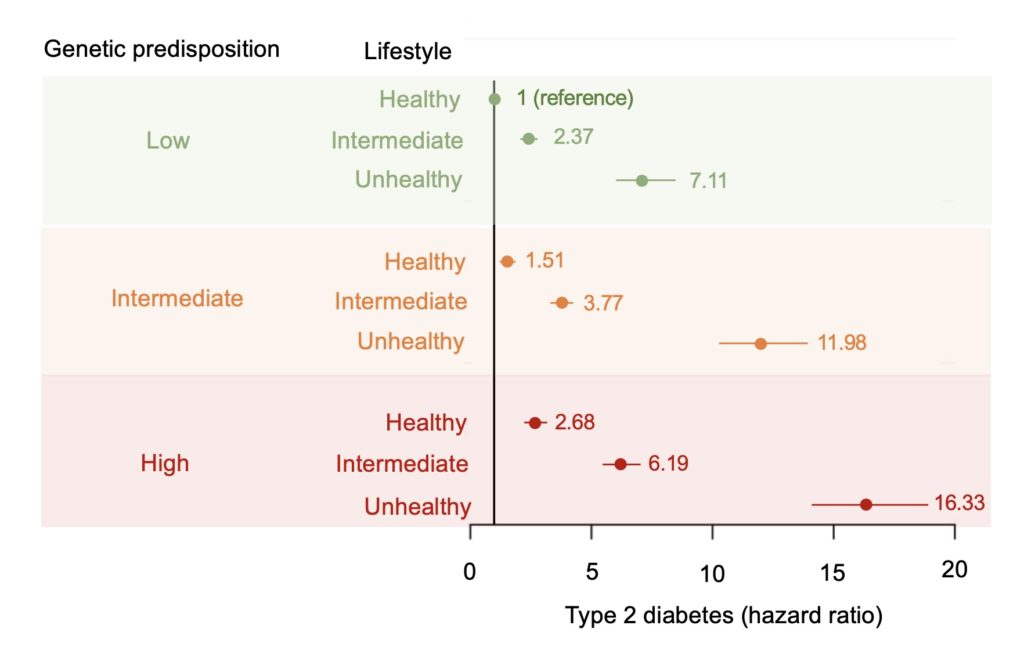
The importance of this interaction between genes and lifestyle in the development of type 2 diabetes is particularly well illustrated by the results of a recent study conducted on 332,251 participants from the UK Biobank research cohort. In this study, researchers separated the cohort members according to their genetic risk score (low, intermediate, and high) and, within each category, according to the quality of their lifestyle (favourable, intermediate, and unfavourable), which was determined based on the participants’ BMI, level of physical activity, diet, and smoking status. This approach allowed researchers to examine the extent to which adopting a healthy lifestyle could mitigate the risk associated with a high genetic predisposition to type 2 diabetes.
Unsurprisingly, the researchers observed that the combination of a high genetic predisposition and an unhealthy lifestyle is associated with the greatest increase in the risk of T2D, with the risk increasing more than 16-fold compared to individuals with a low genetic risk and a healthy lifestyle (Figure 1). The good news, however, is that this increased risk can be significantly reduced by adopting a more favourable lifestyle, both in individuals with a high genetic risk (2.68 vs. 16.33) and those with an intermediate risk (1.51 vs. 11.98). Particularly interestingly, the influence of lifestyle remained significant even in individuals with a low genetic predisposition. In this group, an unhealthy lifestyle was associated with an approximately sevenfold increased risk of type 2 diabetes compared to a healthy lifestyle. These results clearly illustrate that genes are not predetermined. In other words, not smoking, eating a varied diet rich in plant-based foods, maintaining a healthy weight, and exercising regularly are all actions that can effectively prevent type 2 diabetes, regardless of one’s underlying genetic risk.
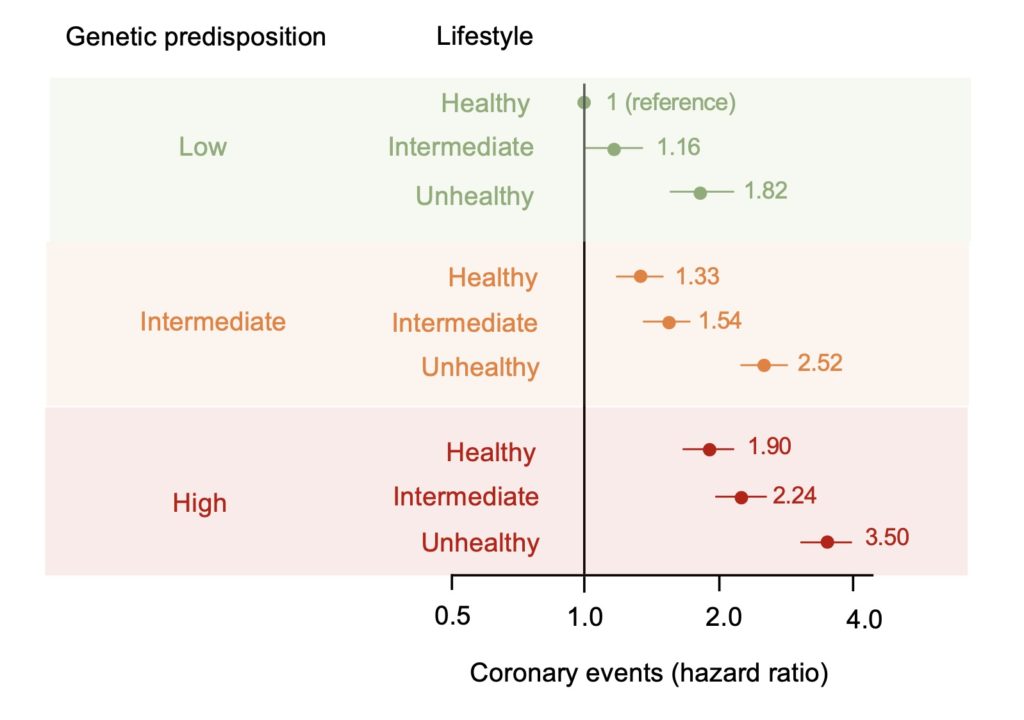
These observations are consistent with previously published findings in the field of cardiovascular disease; for example, one study showed that simply adopting a healthy lifestyle allows individuals with a high genetic predisposition to cut their risk of coronary events in half(Figure 2). Conversely, individuals with genes that should theoretically protect them from coronary heart disease, but who lead an unhealthy lifestyle, see their risk of developing these diseases increase and become similar to that of high-risk individuals who adopt healthy lifestyle habits.
These observations illustrate that our destiny is not entirely determined at birth; even if we are born with a genetic predisposition to diabetes or cardiovascular disease, these genes are only one aspect involved in the development of these diseases. In other words, our genetic makeup establishes certain predispositions, but their impact on health largely depends on their interaction with lifestyle habits and the environments in which we live, work, and evolve on a daily basis. Thus, even if we cannot modify the genes we inherit, it is possible to act on several factors that influence their expression, and consequently, significantly reduce the risk of developing diabetes or cardiovascular disease.