


Dr Martin Juneau, M.D., FRCP
Cardiologue, directeur de l'Observatoire de la prévention de l'Institut de Cardiologie de Montréal. Professeur titulaire de clinique, Faculté de médecine de l'Université de Montréal. / Cardiologist and Director of Prevention Watch, Montreal Heart Institute. Clinical Professor, Faculty of Medicine, University of Montreal.
See all articlesOverview
- Plastics used in food production and packaging release toxic chemical compounds such as phthalates and bisphenols, two classes of endocrine disruptors.
- Many of these compounds migrate into the food we consume and can be detected in the urine of the vast majority of the population.
- A study shows that implementing measures to minimize the use of plastic materials in the food chain could substantially reduce this contamination.
Now ubiquitous in our daily lives, plastics have radically transformed many aspects of our society in fields as diverse as medicine, aerospace, construction, sports, and food packaging. This dependence on plastic, however, comes at a high environmental cost, not only because these synthetic polymers are made from polluting fossil fuels (oil, gas, and coal), but also because they have the major drawback of being poorly recycled. It is estimated that approximately 7 billion tons of plastic waste have accumulated in the environment since 1950, and that the fragmentation and erosion of this waste generate tiny particles called microplastics (less than 5 mm in diameter) and nanoplastics (less than 1 μm in diameter). Recent studies suggest that these particles can penetrate the human body and could contribute to the development of cardiovascular diseases and dementias such as Alzheimer’s disease.
In addition to these microparticles, another source of plastic contamination comes from certain molecules released by these polymers that can migrate into the human body. This is particularly true of bisphenols and phthalates, two classes of chemical compounds that are endocrine disruptors (EDs), meaning they have the property of interfering with the functions of organs and/or hormones involved in physiological processes that depend on hormonal signals (e.g., bodily development, metabolism, and reproduction, among others).
Food, a major source of contamination
A growing body of research suggests that a significant portion of this contamination from plastic derivatives comes from what we eat every day. Several sources can contribute to this contamination: the environment (particularly soil and water), agricultural practices, industrial processing, packaging, and finally, food storage and preparation. It appears that the use of plastic materials in the food chain, and especially the prolonged contact of food or beverages with plastic packaging, causes these contaminants to migrate into food and exposes consumers to measurable amounts of these chemical compounds (see our article on this topic). This is especially true for ultra-processed foods, which are in close contact for several weeks, and sometimes even several years, with the chemical compounds present in their packaging. This contamination is far from minor or anecdotal: for example, studies show that virtually all Canadians aged 6-79 have detectable levels of phthalates in their urine.
Reducing exposure to plastic contaminants
The results of the PERTH (Plastic Exposure Reduction Transforms Health) study, conducted in Australia, clearly illustrate the importance of diet in involuntary exposure to plastic derivatives. In this study, researchers first observed the presence of a range of these contaminants in the urine of almost all participants, particularly several types of phthalates and bisphenols (Figure 1). Not only are these compounds ubiquitous, but in some cases their levels are well above permitted limits; for example, the measured amounts of BPA exceed the limit set by the European Food Safety Authority (EFSA) (0.2 ng per kg per day) by nearly 100 times.
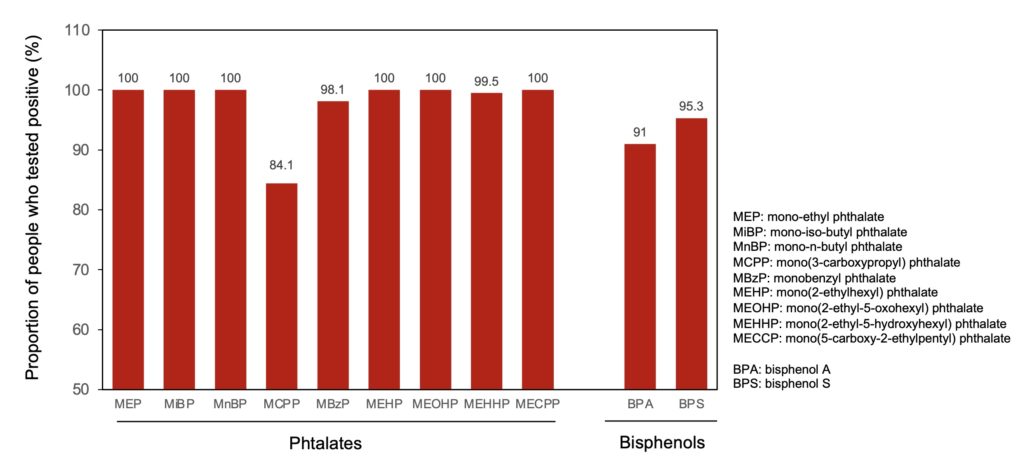
Analysis of the volunteers’ dietary habits revealed that the main factors contributing to the presence of these contaminants are plastic packaging, highly processed foods, and canned foods.
These results prompted researchers to assess whether reducing exposure to plastic, particularly through diet, could reduce urinary concentrations of these chemicals. Three approaches were tested, alone or in combination:
– Plastic-restricted diet. During the study, researchers provided a subgroup of participants with food from producers who minimized all points of contact with plastics, from the production site to the point of consumption. Simultaneously, participants were instructed not to consume ultra-processed, plastic-packaged, or canned foods.
– Plastic-free food preparation equipment. Another subgroup was instructed not to use any plastic-containing products for storing, preparing, and handling food (e.g., cooking utensils and containers).
– Plastic-restricted personal care products. The researchers provided a subgroup of participants with hygiene products (e.g., soap, shampoo and makeup) free of plastic-derived contaminants.
In all cases, participants in the different intervention groups were followed for a period of 7 days, and the levels of plastic contaminants in their urine were compared to those measured in a control group, where participants had made no changes to their habits.
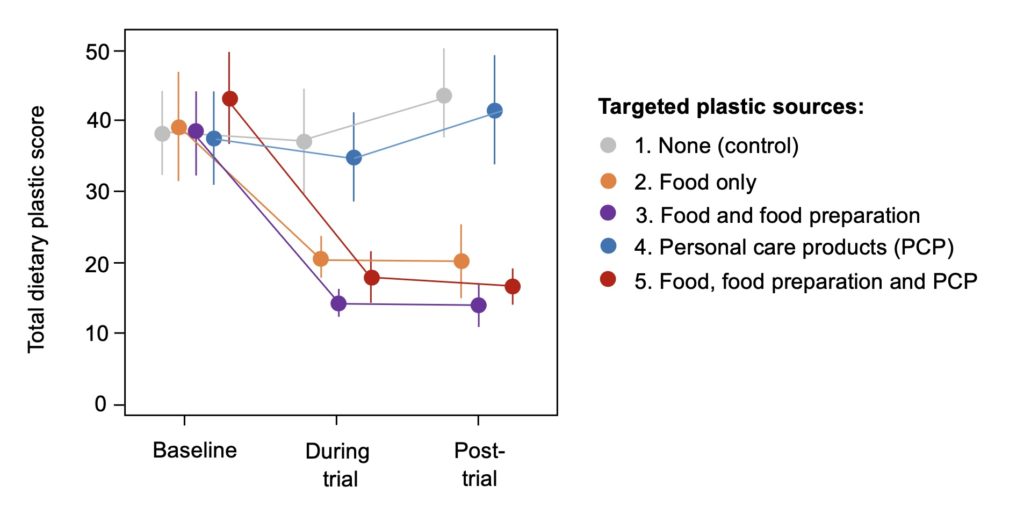
The main conclusion of the study is that reducing the use of plastic materials in the food production chain represents the best approach to reducing the population’s exposure to plastic-derived contaminants. As illustrated in Figure 2, the greatest reduction in exposure is achieved primarily among people who consumed food that had not been in contact with plastic, whereas omitting plastic from food preparation (e.g., cooking utensils) or from personal hygiene products only marginally improves this protection.
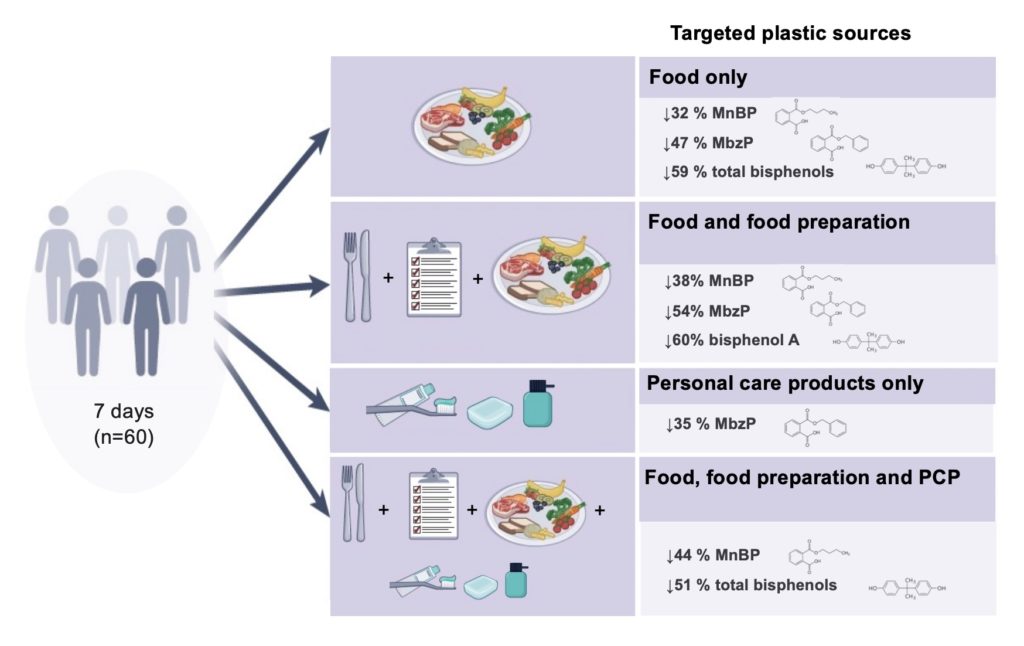
Further analysis shows that the reduction in exposure to plastic contaminants appears to be primarily due to a significant reduction (on the order of 50%) in the levels of two types of phthalates (MnBP and MbzP) and bisphenols (Figure 3). However, plastics can contain up to 16,000 distinct chemical compounds, at least 25% of which are known to be potentially harmful, and it is therefore possible, even likely, that exposure to some of these molecules is also reduced by these interventions.
Towards a comprehensive intervention approach
Contamination of the food chain by plastic-derived compounds is a widespread problem, especially in the current context of ever-increasing use of these materials. The study shows that individuals can reduce their exposure to these contaminants by avoiding certain food products that come into close contact with plastics, particularly ultra-processed foods, but these measures are insufficient given the current scale of contamination. For example, even by working closely with more than 100 producers to minimize the use of plastic in food production, processing, and distribution, researchers were unable to completely prevent the ingestion of hazardous chemicals associated with plastic. Exposure to plastic-associated chemicals is therefore not simply a matter of individual consumer choice, but rather a global public health issue that requires strong new regulatory measures to curb this source of contaminants harmful to public health. In this sense, we could draw inspiration from the regulations concerning the use of lead in products such as paint and gasoline,which have drastically reduced the many toxic effects associated with this heavy metal.