


Dr Martin Juneau, M.D., FRCP
Cardiologue, directeur de l'Observatoire de la prévention de l'Institut de Cardiologie de Montréal. Professeur titulaire de clinique, Faculté de médecine de l'Université de Montréal. / Cardiologist and Director of Prevention Watch, Montreal Heart Institute. Clinical Professor, Faculty of Medicine, University of Montreal.
See all articlesOverview
- Participating in all sports is associated with a significant reduction in the risk of premature death.
- However, some studies suggest that the extent of these benefits may vary depending on the type of sport.
- This seems particularly true for racquet sports like tennis, where a greater reduction in the risk of overall and cardiovascular mortality is observed than with other activities.
Several epidemiological studies have shown that sedentary people have a higher risk of premature death than physically active people. For example, a study that followed 16,000 Harvard University alumni for 20 years found that the most active men had a 43% lower incidence of cardiovascular death and a 23% lower incidence of all-cause mortality compared to more sedentary men. Similar results were obtained by the MRFIT (Multiple Risk Factor Intervention Trial), where regular physical activity was associated with a 37% reduction in death from cardiovascular disease and a 27% reduction in all-cause mortality. In both studies, the physical activity levels achieved by a large proportion of the active participants were in the range of 7.5–22 METhours per week, which roughly corresponds to about 30–60 minutes per day, depending on the type of activity (see the box for the MET calculation). It is on the basis of these studies that all organizations dedicated to the prevention of chronic diseases, whether cardiovascular disease, diabetes, or cancer, recommend a minimum of 150 minutes of physical activity per week to reduce the incidence and mortality associated with these diseases.
Exercise Intensity and Volume
The intensity of exercise is generally expressed in metabolic equivalents (METs), using basal body energy expenditure at rest as a reference. For example, brisk walking results in an energy expenditure three times greater (3 to 4 METs) than remaining at complete rest (1 MET), which is considered moderate-intensity physical activity. The energy expenditure of running or a singles tennis match, on the other hand, is six times greater than at rest (6 to 8 METs), which is considered vigorous-intensity physical activity.
The volume of exercise performed by a person can be easily calculated by multiplying the duration of the exercise by its intensity. Thus, 150 minutes of moderate activity (3-4 METs) or 75 minutes of vigorous activity (8 METs) both correspond to a volume of 600 MET-min per week or 10 MET-h per week.
While the health benefits of physical activity in general are very well documented, the vast majority of studies on this subject have focused primarily on the volume of activity performed by participants (in MET hours per week, for example), regardless of the type of sport practised. However, there are significant differences in the physiological adaptations associated with practising different sports: for example, while endurance sports are more likely to improve cardiovascular function and aerobic capacity, strength sports primarily affect muscle function and bone health. Each sport involves a unique set of movements performed in specific physical, psychological, social, and environmental contexts, and these could, in theory, all have different impacts on health and longevity.
Comparison of different types of exercise
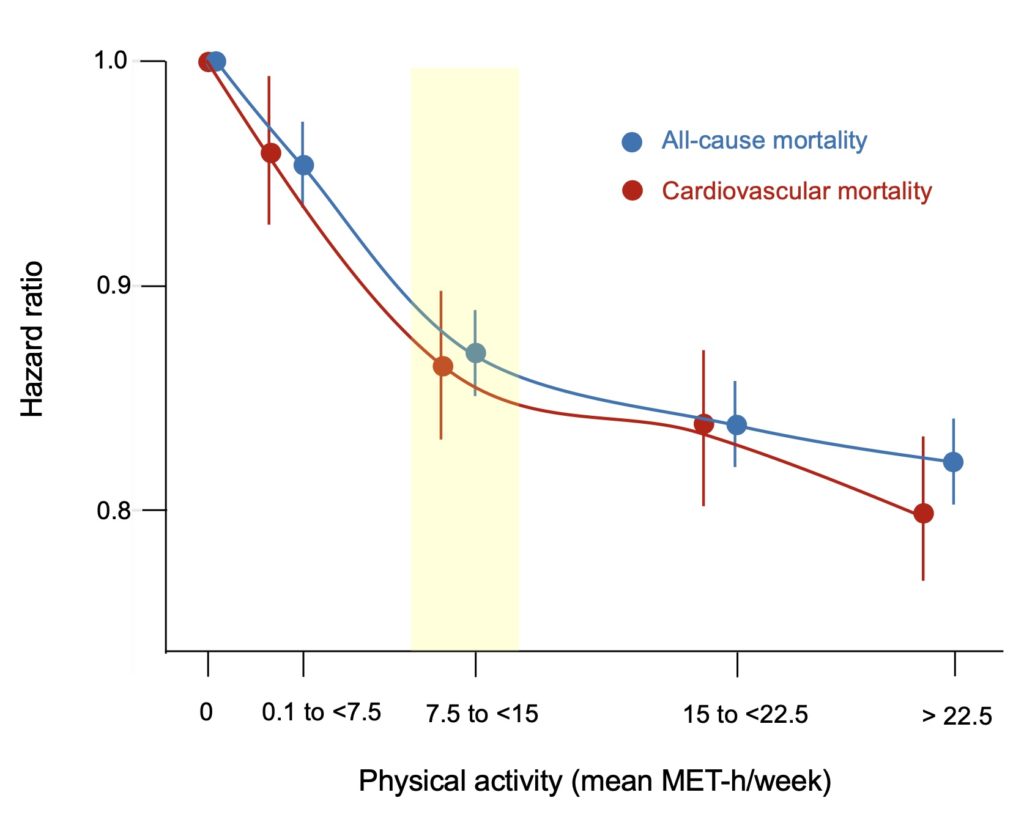
Some studies do indeed suggest that the benefits of physical activity on reducing the risk of premature mortality may be slightly greater for certain activities. One of the best examples is a study that examined the practice of seven distinct sports (walking, aerobic exercises, cycling, golf, swimming, running and racquet sports) by people with an average age of 70 years: unsurprisingly, the researchers first observed that the practice of these sports in general was associated with a reduction in the risk of all premature mortality and cardiovascular mortality, with a reduction of about 13% in risk in moderately active people (7.5-15 MET-h per week), which corresponds to about 150-300 minutes of physical activity per week (Figure 1). As is the case in the majority of studies (see here, for example), this moderate level of activity allows one to obtain most of the benefits conferred by exercise on the reduction of mortality, whereas these reductions become proportionally smaller for larger volumes of exercise (15 MET-h per week and more).
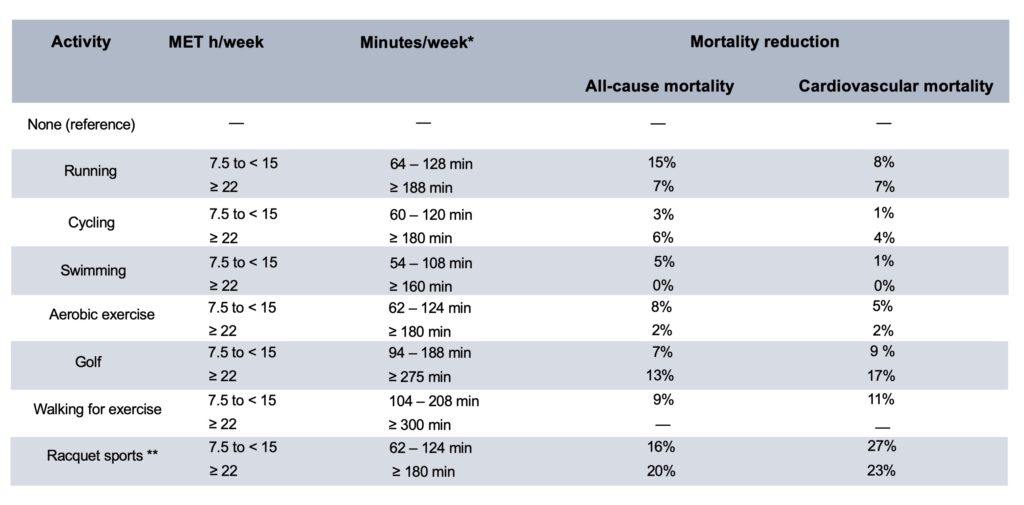
The study also suggests that the reductions in mortality risk associated with exercise may vary significantly depending on the type of sport practised (Table 1). Indeed, runners, brisk walkers, and especially racquet sport participants show a greater reduction in the risk of all-cause and cardiovascular mortality than those involved in other activities. For example, playing 1-2 hours of tennis per week is associated with a 27% reduction in cardiovascular mortality and a 16% reduction in all-cause mortality, much greater protective effects than those observed with other activities (with the notable exception of running, which reduces all-cause mortality by 15%). A greater volume of exercise does not increase the benefits conferred by any sport, including tennis, except for golf, where increasing the time spent playing doubles its protective effects on cardiovascular and all-cause mortality.
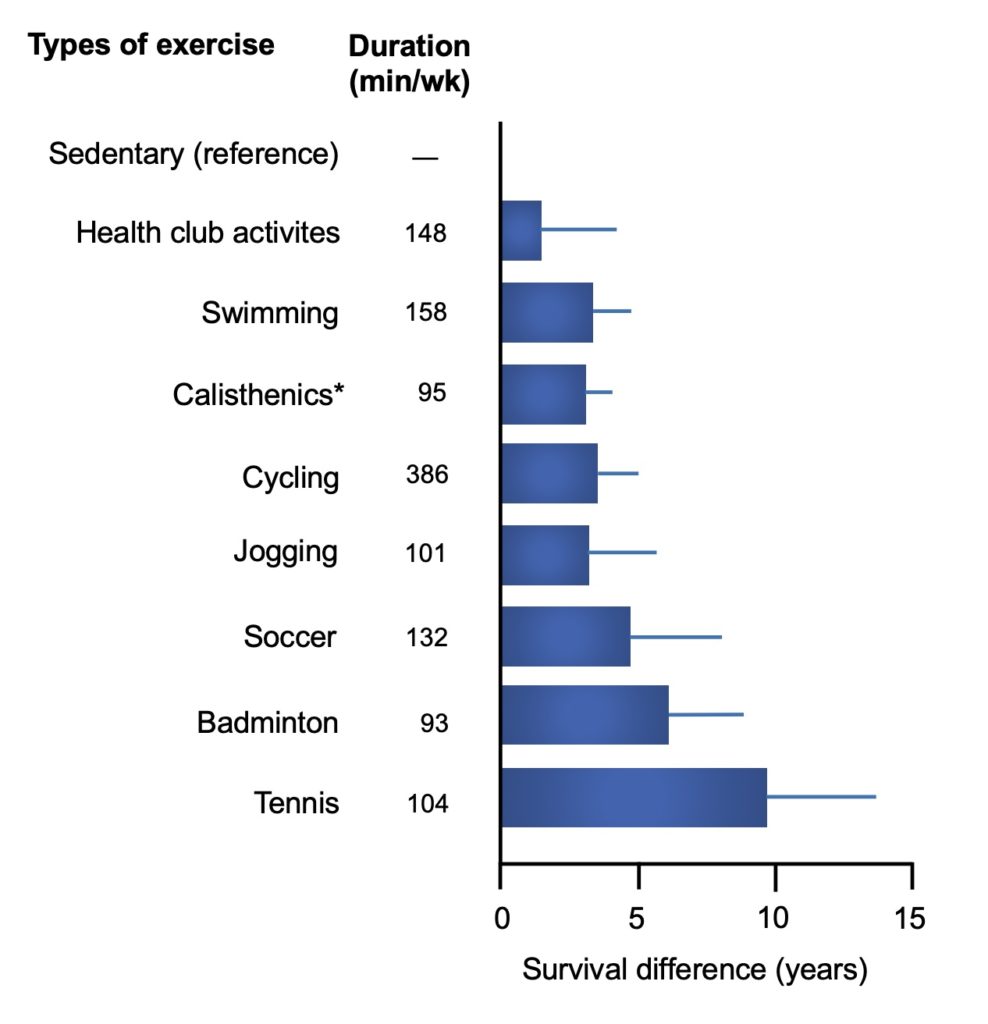
Although such a marked superiority of racquet sports like tennis over other types of activities is not observed in all studies (see hereand here, for example), playing these sports remains among those most closely associated with a reduced risk of mortality in most studies. For example, studies conducted in Denmark and the United Kingdom showed that tennis and badminton players had an approximately 20% lower risk of all-cause mortality than those who practised other sports such as swimming, cycling, or jogging. An analysis of 10 distinct physical activities, ranging from moderate to vigorous intensities, revealed that playing tennis, running, and brisk walking were associated with the greatest reduction in the risk of cardiovascular disease .
Overall, these observations suggest that racquet sports like tennis could represent a particularly beneficial activity for improving health and longevity. This is particularly well illustrated in the Danish study mentioned earlier, where the reduction in mortality risk observed in tennis players translates into an increase of approximately 10 years in their life expectancy (Figure 2).
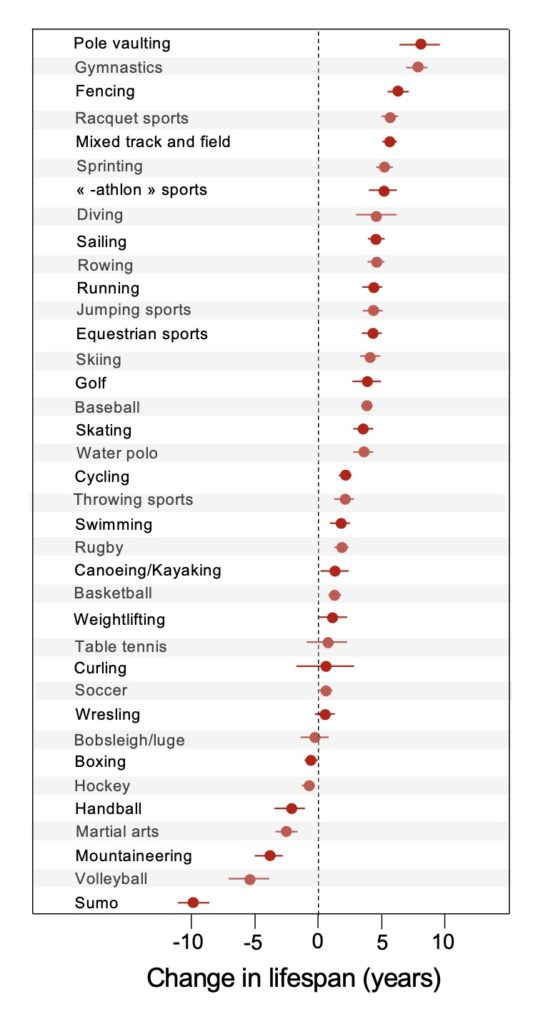
It is also interesting to note that in studies comparing the life expectancy of national and international level athletes in different sports , tennis players are among those with the greatest increases in longevity compared to the general population (Figure 3).
Tennis, a complete sport
The additional benefits attributed to tennis in these various studies are biologically plausible, as playing this sport improves several aspects known to play an important role in maintaining good health. A typical tennis match can last from 30 minutes to several hours, interspersed with rapid changes of direction and intense efforts, as in high-intensity interval training (HIIT). Studies show that this training method, where short periods of intense exercise alternate with periods of lower-intensity recovery, leads to significant improvements in aerobic capacity and certain cardiometabolic risk factors, and could therefore greatly contribute to the benefits attributed to tennis, both from a physical and mental perspective (Table 2).
| Potential benefits | Description | Sources |
|---|---|---|
| Physical effects | ||
| Increased aerobic capacity | Tennis players exhibit higher levels of physical fitness than moderately active control subjects of the same age and sex. | Swank et al. (1998) |
| Decrease in resting heart rate and blood pressure | A study reports that in 25 men and 25 women (aged 31-55) whose only regular physical activity was tennis (9.7-11.1 hours/week), the average resting heart rate was 54 beats/min in men and 61 beats/min in women. The average resting blood pressure was 117/75 mmHg in men and 107/68 mmHg in women. | Vodak et al. (1980) |
| Blood sugar control | A study conducted on 12 tennis players with type 2 diabetes, who played 90 minutes of tennis twice a week for six weeks, showed a decrease in average glucose concentration from 10.5 mmol/L at the start to 8.6 mmol/L after the 6 weeks of training, a reduction of nearly 20%. | Kovacs et al. (2016) |
| Improved muscle tone, strength, and flexibility | Tennis players are stronger and their muscles are more resistant to fatigue than those of sedentary people, both in young people (30 years old) and older people (65 years old). | Swank et al. (1998) |
| Increase in bone density | In general, bone mineral content (BMC) and bone mineral density (BMD) are consistently higher in the dominant arm (playing arm) than in the non-dominant arm. Furthermore, BMC and BMD are higher in the hip and lumbar spine of tennis players than in control subjects. | Pluim et al. (2007) |
| Reduction of body fat | Senior male tennis players have significantly less body fat than an active control group of the same age. The youngest veterans (aged 40 to 59) and the oldest veterans (over 60) were on average 3% leaner than moderately active controls who did not play tennis (17 to 20.5% vs. 21 to 25%, respectively). | Vodak et al. (1980) |
| Cognitive effects | ||
| Improved reaction times | The performance of older tennis players on simple choice and movement time tasks was significantly superior to that of sedentary adults of the same age. | Spirduso and Clifford (1978) |
| Stress and psychological health | Playing tennis had a therapeutic effect, resulting in reduced stress and an improvement in overall health. | Kovacs et al. (2016) |
Table 2. Benefits associated with regular tennis practice.
In closing, it is important to mention that most studies examining the health effects of tennis involve small sample sizes, making them more susceptible to various confounding factors, such as the socioeconomic status and overall health of participants. This makes it difficult to accurately determine the extent of the benefits specifically associated with racquet sports.
However, there is no doubt that tennis possesses several characteristics that make regular practice highly beneficial. In addition to its numerous positive effects on human physiology, it is a sport accessible to the vast majority of people, can be played at any age of life, from childhood to old age, and takes place in an environment that fosters social interaction, essential for psychological well-being. While participation in all sports should be strongly encouraged, the sum of all the physical and mental benefits attributable to regular tennis practice makes it a top choice for improving the overall health and well-being of the population.